

No-code AI is moving fast.
Regulated industries are moving carefully.
And in 2026, the gap between those two realities is becoming impossible to ignore.
Banks, healthcare providers, insurers, and public sector organizations are under pressure to adopt AI—yet they operate under strict rules around data privacy, auditability, explainability, and vendor risk.
This raises a critical question:
Can no-code AI really work in regulated environments?
The answer is yes—but only if governance, control, and transparency are designed in from day one.
Why Regulated Industries Are Cautious About No-Code AI
No-code platforms promise speed.
Regulated industries demand certainty.
The challenge is not innovation—it’s accountability.
In finance, healthcare, and government, AI systems must answer hard questions:
- Who approved this model?
- What data was used to train it?
- Why did it produce this output?
- Can we reproduce and audit the decision?
- What happens if the vendor changes or fails?
Traditional no-code AI tools often fail here. They optimize for ease of use, not for regulatory scrutiny.
That’s why many early no-code AI deployments stall—or get shut down—once compliance teams get involved.
The New Reality: No-Code AI Must Be Governed, Not Just Built
In 2026, enterprise AI development is no longer about model accuracy alone.
It is about:
- Traceability
- Explainability
- Risk management
- Operational control
For regulated industries, no-code AI must behave like enterprise software—not experimental tooling.
This requires a shift in how organizations think about no-code AI.
The real question is no longer:
“Can business teams build AI without developers?”
It is:
“How do we govern no-code AI at enterprise scale?”
Core Requirements for No-Code AI in Regulated Industries
1. Built-In Audit Trails
Every AI action must be traceable.
That means:
- Who created the model
- Who modified it
- When changes were made
- What data sources were connected
Without audit logs, no-code AI becomes a black box—something regulators will not accept.
Governed no-code platforms treat auditability as a core feature, not an afterthought.
2. Model Explainability (Not Just Accuracy)
In regulated environments, “the model said so” is not an explanation.
Organizations must be able to:
- Explain how outputs are generated
- Identify influencing variables
- Demonstrate fairness and consistency
This is especially critical in finance (credit decisions), healthcare (clinical support), and government services.
No-code AI must expose logic paths and decision reasoning in a way non-technical reviewers can understand.
3. Data Privacy & Residency Controls
Regulated industries cannot afford uncontrolled data flow.
Key requirements include:
- Clear data boundaries
- Role-based access controls
- Regional data residency compliance
- Explicit control over external model calls
No-code AI platforms that abstract away data handling without transparency introduce unacceptable risk.
In 2026, compliance teams expect to see exactly where data goes—and who can touch it.
4. Vendor & Platform Risk Management
One of the biggest hidden risks in no-code AI is vendor dependency.
Regulated organizations must ask:
- Can we export models and workflows?
- What happens if the vendor changes pricing or terms?
- Can we integrate with our existing infrastructure?
Enterprise-ready no-code AI platforms allow organizations to retain ownership, portability, and long-term control.
How Enterprise AI Strategy Must Adapt in 2026
The rise of no-code AI does not eliminate the need for strategy—it raises the bar.
Successful organizations are adapting in three key ways:
- Shifting from experimentation to governed deployment
- Embedding compliance into AI workflows from day one
- Treating AI as operational infrastructure, not a side project
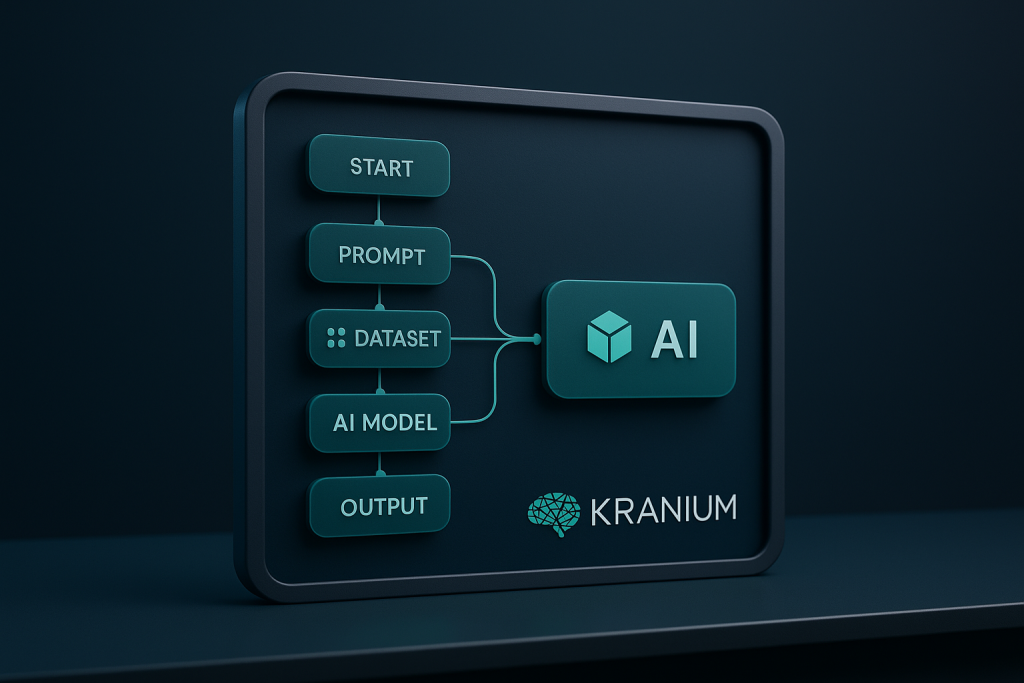
This is where platforms like Kranium play a critical role.
Instead of simply enabling AI creation, the focus moves to:
- Controlled deployment
- Policy-driven governance
- Explainable systems
- Enterprise-grade oversight
No-code AI succeeds in regulated industries only when speed and safety are designed together.
Final Thought: Control Is the Real Competitive Advantage
In 2026, no-code AI is no longer a question of “if” for regulated industries.
The real differentiator is how responsibly it is deployed.
Organizations that treat governance as a blocker will fall behind.
Those that treat governance as a design principle will scale faster—and safer.
No-code AI for regulated industries is not about removing control.
It’s about putting control where it belongs.